
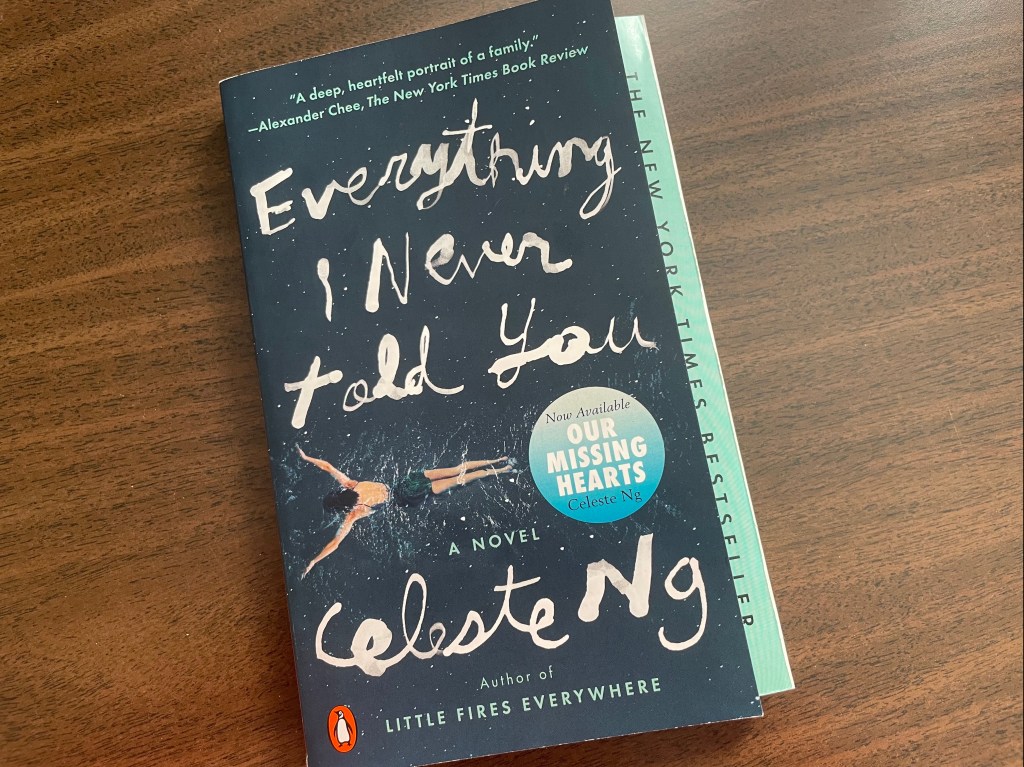
I’ve been meaning to read Celeste Ng for a long time now.
Obviously she’d been talked about a lot, having been on bestsellers lists and winning awards, but the real reason I picked her up is because a friend suggested her after I raved about how much I love Sally Rooney. Now that I’ve read Everything I Never Told You, I get the connection. What I love most about Rooney is powerfully, wholly evident in Ng’s writing as well: the excitement and intrigue of the story comes from how intensely real it is.
I’ve always said that my favourite stories and the ones I most want to write are the ones where, honestly, not a whole lot happens—on the outside, anyway. Inside these complex, flawed, misguided characters, however, there’s SO much going on. That’s where the conflict is. People grappling with how they were raised, with how they acted, with who they all. My favourite books are the ones where people are at war with themselves and I think that’s what makes them so relatable. So worthwhile. Aren’t we all just living rather mundane lives on the outside—not chasing our love interests down at the airport gate, not confronting our child’s killer—while fighting battles, overcoming our insecurities, finding out who we are on the inside?
This is exactly what Ng does. Each character in this family is so wrapped up in their own worlds that they forget to check in on each other, forget to support each other at a time of having lost the centre of their whole world. From the father, James, who wants to blend in and seeks an affair with a woman who makes him feel ordinary, to the mother who wants to stand out after succumbing to a life she never wanted, every single person has a reason for being who they are and doing what they do.
Nath and Lydia’s relationship is truly fascinating and one that, I think, accurately depicts the teenage sibling dynamic. They would do anything for each other, they’re the only ones who know each other and see what the other is going through, while still holding a deep-rooted resentment and jealousy. Lydia is motivated by making her brother angry, pissing him off, but only because she doesn’t like how easily excited he is to go off to college. It’s complex, it’s poignant, and it’s so real.
At yet, perhaps the only emotionally in tune one is Hannah. The younger sister who seems to be tragically overlooked, she perhaps, knows the most about each individual in the family while having the best view of the relationships existing in the household from her place between the table legs. She sees what the others don’t, and isn’t that what the whole novel is about—seeing through the eyes of others? Every single character is so wrapped up in their own insecurities, their own aspirations, their own futures that they don’t see what’s going on around them—Lydia’s rebellion, Jack’s affection for Nath, Nath’s loneliness.
It’s safe to say I’m very excited to read more NG (I’m heading to the library this afternoon to pick up more!), and not just as a reader, but as a writer, too. My current work in progress is similar to this novel in a lot of ways, actually. Not only does it use dual timelines, but it is a largely internal story about the insecurity, control, and the secret resentments and secrets harboured in young friendships. Like this novel’s mystery surrounding Lydia’s death, mine has elements of mystery (or thriller, even), though it’s just as much about the mystery of the person than it is about the plotted mystery itself.
Because aren’t people, really, the biggest mysteries of all?
 MEGAN ARDEN GALLANT
Leave a comment